01 / Paper overview
Abstract
Speech synthesis technologies have enhanced the convenience of voice interaction while also intensifying security risks such as impersonation and voice fraud. These risks are particularly serious in real-time communication scenarios, such as online meetings, where speech deepfakes may directly interfere with real-time decision-making and cause financial losses. However, existing detection methods typically rely on complete utterances and require the additional deployment of large-scale pretrained feature extractors, limiting their practical applicability.
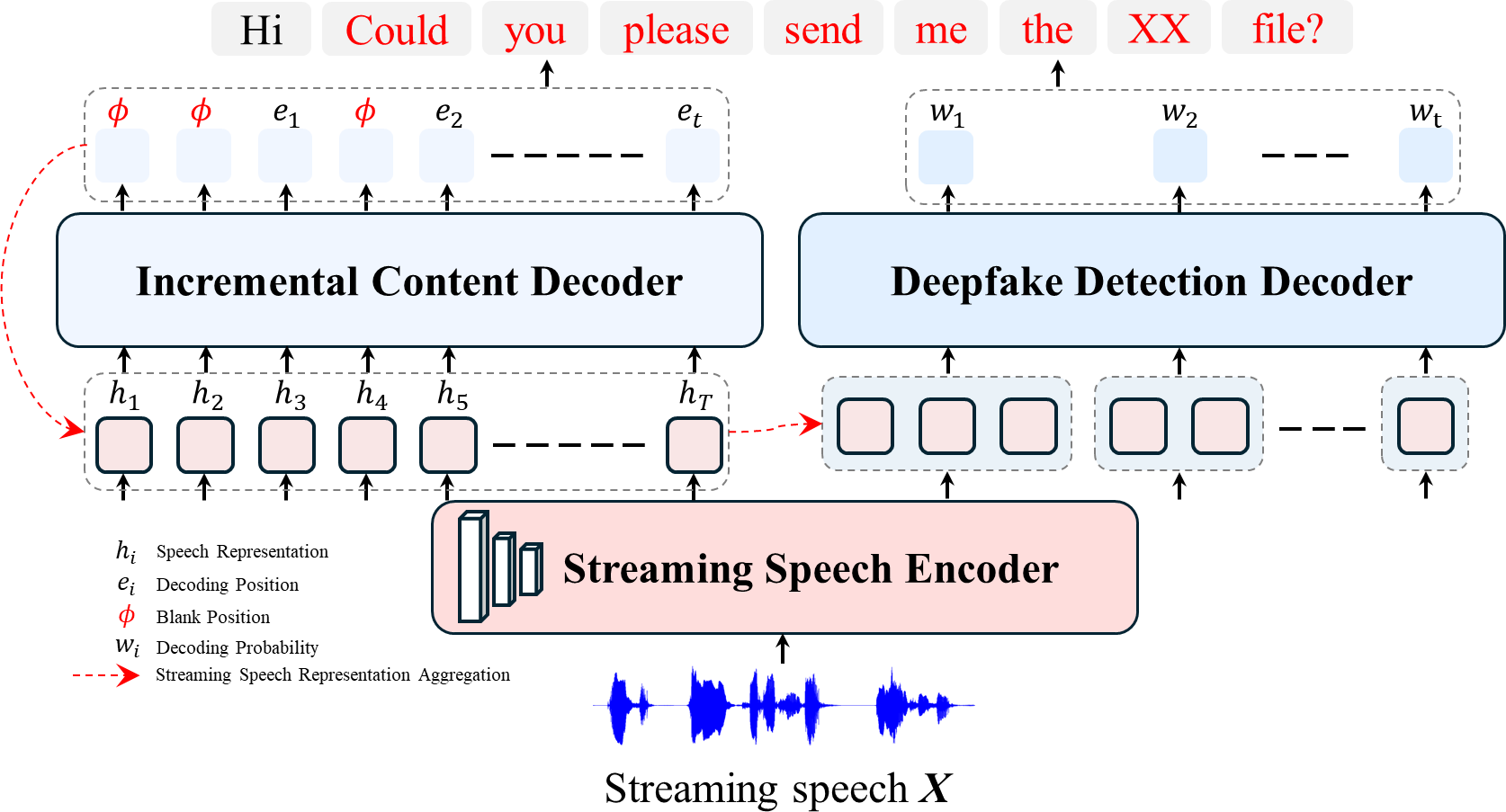
In this paper, we propose StreamFake, a low-overhead and robust word-level streaming speech deepfake detection system for real-time communication. We observe that streaming automatic speech recognition has been widely deployed in voice interaction and that its encoder provides incremental acoustic representations containing rich discriminative information. Further analysis demonstrates that speech recognition and deepfake detection do not exhibit substantial optimization conflict. Based on these insights, we integrate speech recognition and deepfake detection into a unified streaming framework. Specifically, StreamFake reuses the streaming encoder to extract representations, aggregates word-level acoustic representations according to the temporal boundaries produced by the content decoder, and employs a lightweight detection decoder to synchronously produce authenticity predictions. This design introduces only 0.22M additional parameters without degrading the original transcription performance. Extensive experiments demonstrate that StreamFake achieves state-of-the-art streaming detection performance across different detection latencies. Evaluations involving black-box voice-cloning APIs and real-world communication environments further validate its robustness and practical applicability, consistently outperforming baseline methods.